F1 Legends of the Golden Age: Drivers, Engineers and Iconic Races
From Fangio to Schumacher: the drivers, engineers and iconic races that defined Formula 1's golden age, 1950 to 1999, in one complete history.
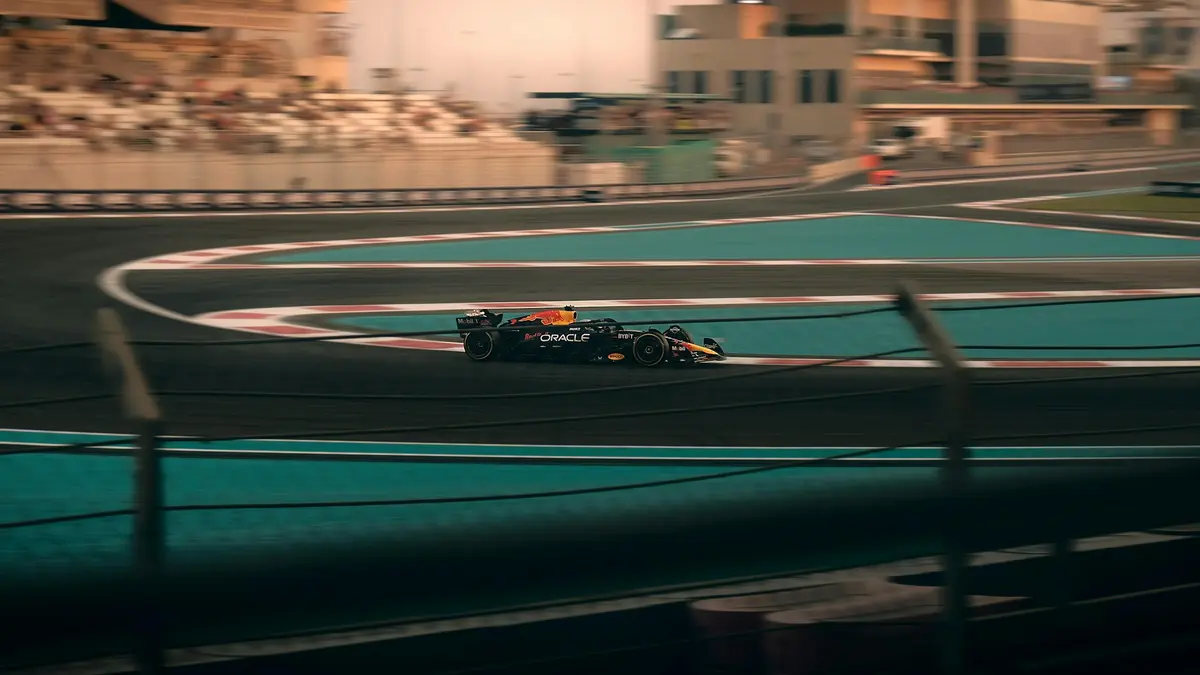
The roar of a Ford-Cosworth DFV through the concrete canyons of Long Beach. The scream of a Ferrari flat-twelve above Monza's Parabolica. A man climbing back into the cockpit six weeks after the flames of the Nürburgring. To understand the F1 golden age legends is to understand a sport built on bravery, mechanical sympathy and raw engineering genius, played out on circuits where the walls were never far away.
From the inaugural 1950 championship at Silverstone through to the final howl of the three-litre V10 at Suzuka in 1999, Formula 1 produced drivers, engineers and team principals whose achievements still define the benchmarks of the sport. This is the story of the men who built that era: the five-time Maestro, the meticulous Scot, the fearless Austrian who cheated death, the American who brought ground effect to California, the quiet engineer who changed the shape of every car that followed, and the German who closed the century with an iron grip on the sport's future.
The 1950s: Fangio's Supremacy and the Front-Engined Era
Formula 1 in its opening decade was a sport still tethered to the pre-war philosophy of racing. Cars were front-engined, tyres were narrow cross-plies, and drivers wore short-sleeved shirts and leather helmets. Into this world stepped a middle-aged Argentine mechanic-turned-racer who would set a benchmark no one would match for nearly half a century.
Juan Manuel Fangio arrived in Europe with nothing but reputation and a pair of hands trained on the rough dirt tracks of South America. His victory at the 1950 Pau Grand Prix, aboard a Maserati 4CLT/48 just weeks before the inaugural World Championship began at Silverstone, was a statement of intent. Pau's narrow, twisting street circuit demanded the sort of delicacy that Fangio had made his trademark, and the Maestro despatched the French field in a manner that left no doubt about what was coming. Over the next seven seasons, Fangio would win five World Championships for four different constructors, a record of versatility that still stands as unique in the sport's history.
Behind Fangio stood a generation of rivals whose names still carry weight. Luigi Villoresi, the urbane Italian aristocrat of the wheel, led a crushing Ferrari 1-2-3 at the 1952 Valentino Grand Prix in Turin, driving the Lampredi-designed Ferrari 500 that would dominate the 2.0-litre Formula 2 regulations under which the World Championship was run in 1952 and 1953. Villoresi's mastery of the Ferrari 500 set the template for Scuderia Ferrari's first era of sustained success and brought along a young protégé named Alberto Ascari. Meanwhile, at the 1954 Pau Grand Prix, Jean Behra pulled off one of the great upsets of the decade, steering Amédée Gordini's fragile Type 16 to a storybook victory over the factory Ferrari 625s of Maurice Trintignant and Giuseppe Farina. Gordini operated on a shoestring from a Paris workshop, and Behra's triumph over 109 laps of stone curbs and hay bales embodied the romantic, David-and-Goliath character of 1950s racing.
The decade closed with a British coronation. Mike Hawthorn, famed for the bowtie he wore in the cockpit and for a driving style that combined bravery with wry humour, became Britain's first Formula 1 World Champion in 1958. Driving the front-engined Ferrari 246 Dino, Hawthorn edged Stirling Moss by a single point after a season-long duel that defined the end of the front-engined era. His championship was a last salute to the old order: within eighteen months the rear-engined revolution begun by Cooper would sweep Maranello's front-engined machinery into the museum.
The 1960s: Clark, Stewart and the Precision Era
If the 1950s belonged to Fangio, the 1960s belonged to two men whose genius rewrote the definition of a racing driver. Jim Clark and Jackie Stewart did not simply win races; they reduced them to an act of clinical, mechanical empathy. They were artists of the pedal and the steering wheel, and through them Formula 1 transitioned from the brute-force cigar tubes of the front-engined era into the slender, mid-engined monocoques that would carry the sport into its modern shape.
Clark's partnership with Colin Chapman at Team Lotus produced some of the most beautiful racing the sport has ever seen. The Scot's second World Championship in 1965, alongside his Indianapolis 500 triumph that same season, confirmed him as the fastest driver on Earth on any surface. When he was killed in a Formula 2 race at Hockenheim in April 1968, the paddock was left to wonder what might have been.
Sir Jackie Stewart picked up the torch and carried it with a different kind of brilliance. Meticulous, analytical and unafraid to speak publicly about the appalling safety standards of the era, Stewart won three World Championships and became the first true ambassador-driver of the sport. His 1971 victory at the Spanish Grand Prix, staged on the treacherous Montjuïc street circuit in Barcelona, was a particular masterpiece. Steering the Tyrrell 003-Ford to its maiden victory, Stewart outfoxed the Ferrari 312B of Jacky Ickx over a hillside layout where a single mistake meant contact with an unyielding Armco barrier. The Tyrrell 003 would go on to become one of the most successful chassis of the early 1970s, and Stewart's partnership with Ken Tyrrell defined the ideal of the privateer team raising itself to championship level on the strength of engineering discipline alone.
The late 1960s also produced one of the most haunting chapters in the story of the F1 golden age legends. Jochen Rindt, born in 1942 in Mainz and raised in Graz, was the fearless Austrian-German who mastered the radical wedge-shaped Lotus 72 in 1970. With its inboard brakes, side-mounted radiators and Ford-Cosworth DFV V8, the Lotus 72 was a car that demanded everything from its driver. Rindt took it to wins in the Dutch, French, British and German Grands Prix before being killed during practice for the Italian Grand Prix at Monza in September 1970. His points lead was so commanding that no rival could overhaul him, and Rindt became the only posthumous World Champion in Formula 1 history. His widow, Nina, accepted the trophy in his place.
The 1970s: Andretti, Hunt, Lauda, Jones, Scheckter and the Rise of Long Beach
The 1970s was the decade in which Formula 1 became a global television property and in which its drivers became household names. It was also the decade of ground effect, of the fire-breathing twelves from Ferrari and BRM, and of the concrete-lined street circuit that gave Grand Prix racing its first true American foothold: Long Beach, California.
Mario Andretti was the driver who connected every strand of this era. Italian-born and American-raised, he brought the instinct of a dirt-track sprint car racer to the sophistication of Colin Chapman's engineering laboratory. On April 3, 1977, at the United States Grand Prix West, Andretti drove the revolutionary ground-effect Lotus 78 to a landmark victory on the streets of Long Beach, becoming the first American to win a Formula 1 race on home soil. He edged Jody Scheckter's Wolf WR1 and Niki Lauda's Ferrari 312T2 in a classic street fight, and the win set the stage for his 1978 World Championship aboard the definitive ground-effect Lotus 79.
Andretti's Long Beach triumph was one of several races at the venue that shaped the decade. On April 2, 1978, Carlos Reutemann steered the Mauro Forghieri-designed Ferrari 312T3 to victory in the city, securing the first ever Grand Prix win for Michelin radial tyres on a street circuit. A year later, on April 8, 1979, Gilles Villeneuve delivered a rare Grand Slam at the same venue, leading every lap in the Ferrari 312T4 to secure a 1-2 finish alongside teammate Jody Scheckter. It showcased both the howling Maranello flat-twelve and the handling balance that would carry Scheckter to the 1979 World Championship.
The late 1970s also belonged to the rivalry Hollywood would eventually film. James Hunt, the British aristocrat with the matinée idol looks, and Niki Lauda, the clinical Austrian whose horrific crash and recovery at the Nürburgring in 1976 became one of sport's defining moments, staged a championship fight that captured the world's imagination. Hunt took the 1976 title by a single point in the McLaren M23 after Lauda withdrew from a rain-soaked Japanese Grand Prix finale. Lauda returned the favour in 1977, winning his second Ferrari title through surgical consistency.
Alongside them came Emerson Fittipaldi, the Brazilian who had already collected two World Championships by 1974, and Denny Hulme, 'The Bear,' whose 1967 title carried into a decade of gritty McLaren performances. Alan Jones closed the decade by delivering Williams Grand Prix Engineering its first World Championship in 1980, finally rewarding Sir Frank Williams for more than a decade of financial struggle. The 1981 Brazilian Grand Prix then produced one of the era's most infamous team-order disputes, as Carlos Reutemann ignored the 'JONES-REUT' pit board to take victory over his defending champion teammate in the rain at Jacarepaguá. Communication in the era of raw, unshielded cockpits and manual gearboxes was limited to such physical signs, and Reutemann's defiance destroyed his relationship with both Jones and team principal Frank Williams.
The 1980s: Piquet, Prost, Long Beach's Decline and the Championship Legacies
The 1980s was the decade of the turbocharger, of carbon fibre, and of budgets that began to leave the garagistes of the British midlands behind. The decade opened with a final burst of independent spirit and closed with the arrival of the fully professional works team as the dominant model of the sport.
Nelson Piquet was the story of the early part of the decade. On April 12, 1981, the Brazilian delivered one of the most technically cunning victories of the era at the Argentine Grand Prix. Driving the Gordon Murray-designed Brabham BT49C at the Autódromo Oscar Alfredo Gálvez, Piquet exploited a clever hydro-pneumatic suspension system that allowed the car to sit low when in motion, reclaiming the ground-effect downforce that FISA had tried to ban via a mandatory 6cm ride height rule. The Brabham BT49C would carry Piquet to his first World Championship that season, and the affair became a textbook case of how the mechanical era rewarded engineering lateral thinking.
The finest street-circuit drive of the decade came at the 1983 United States Grand Prix West. On March 27, 1983, John Watson achieved the most statistically improbable victory in the sport's history, winning from 22nd on the grid in the McLaren MP4/1C with teammate Niki Lauda coming home second from 23rd. The pair had struggled in qualifying because the harder-compound Michelin tyres refused to come up to temperature on the cold Long Beach streets. On race day the temperature rose, the rubber reached its operating window, and Watson and Lauda carved through the field to produce a 1-2 that left the California crowd in disbelief. Watson crossed the line nearly 30 seconds ahead of Lauda, and no driver has since won from as far back as 22nd. It was also the last Formula 1 race held at Long Beach, which switched to IndyCar the following year, closing a chapter that had produced winners from Andretti, Reutemann, Villeneuve, Piquet, Lauda and Watson in just seven seasons.
Lauda himself had provided one of the decade's finest comeback stories. On April 4, 1982, in only his third race back from a two-year retirement, the Austrian drove the revolutionary carbon-fibre McLaren MP4/1B to victory at Long Beach, silencing every doubter who had suggested that his competitive fire was extinguished. Two years later he would take a third World Championship by half a point from his McLaren teammate Alain Prost, a margin that remains the closest in the sport's history.
Alongside Piquet and Lauda, the 1980s belonged increasingly to the French-born clinical brilliance of Alain Prost and the rising generation of Brazilian Ayrton Senna. Riccardo Patrese, born in Padua on April 17, 1954, quietly became the most enduring driver of the decade. A master of longevity and mechanical sympathy, Patrese participated in 256 Grands Prix across a career that reached from the ground-effect late 1970s into the high-technology early 1990s, taking six victories for Williams, Brabham and Benetton. He was the bridge between eras, the man who raced against both Mario Andretti and Michael Schumacher in their pomp.
The Engineer's Craft: Frank Williams and Harvey Postlethwaite
No honest account of the F1 golden age legends can confine itself to the drivers. The sport of the 1950-1999 period was, above all, an engineering contest, and two British figures stand above all others as the embodiment of that side of the paddock.
Sir Frank Williams was born in South Shields, England, on April 16, 1942. Long before the carbon fibre and active suspension of the 1990s, Frank was a man driven by pure mechanical passion. He had started as a racing driver, funded his dreams by selling groceries, and entered the paddock as a privateer whose early years in the 1960s and 1970s were defined by grit and constant financial peril. Everything changed in 1977, when he founded Williams Grand Prix Engineering with the brilliant young engineer Patrick Head. The breakthrough came with the Williams FW07 in 1979, and by 1980 Alan Jones had delivered the team its first World Championship.
Through the turbo era of the mid-1980s, Williams partnered with Honda to produce the fire-breathing FW11 and FW11B in the hands of Piquet and Nigel Mansell. Despite the life-altering road accident Frank suffered in 1986, his resolve never wavered. The 1990s brought the team's technological high-water mark: the Williams FW14B, designed by Adrian Newey and Patrick Head, featured active suspension, traction control and a screaming Renault V10 that allowed Mansell to crush the 1992 championship. That was followed by Alain Prost's clinical 1993 title in the Williams FW15C, often cited as the most complex racing machine ever to reach a grid. By the time Jacques Villeneuve took the 1997 World Championship in the Williams FW19, the team had accumulated nine Constructors' and seven Drivers' titles, the benchmark for excellence in the mechanical era.
Frank's technical counterpart in the story of British engineering brilliance was Harvey Postlethwaite. The quiet, cerebral Briton first rose to prominence at Hesketh Racing, where his Hesketh 308 took James Hunt to a famous victory at the 1975 Dutch Grand Prix. When Hesketh folded, Postlethwaite moved to Walter Wolf Racing and designed the Wolf WR1, which won its debut race at the 1977 Argentine Grand Prix with Jody Scheckter at the wheel. In 1981 Enzo Ferrari personally recruited Postlethwaite to bring British chassis expertise to Maranello. His Ferrari 126C2 and 126C3 secured back-to-back Constructors' Championships in 1982 and 1983, and he was pivotal in transitioning Ferrari from heavy spaceframe construction to sophisticated carbon-fibre composites capable of handling the turbo V6.
His most enduring legacy was the Tyrrell 019 of 1990. Working alongside Jean-Claude Migeot, Postlethwaite introduced the 'anhedral' high-nose design that aimed to clean up the airflow to the underbody. The innovation revolutionised aerodynamic philosophy: every Grand Prix car built since follows the airflow principles first pioneered by that modest Tyrrell. Postlethwaite was overseeing the Honda RA099 project, which was setting top-three lap times in testing at Barcelona, when he died on April 15, 1999. The programme was shelved, and the paddock was left to wonder what might have been had his final masterpiece reached the grid.
The Schumacher Factor: 1990s Dominance in His Own Era
The final chapter of the golden age belongs to a driver whose arrival was spotted almost in real time. On March 22, 1992, at the Mexican Grand Prix held at the Autódromo Hermanos Rodríguez, a 23-year-old German in his second full season secured his first Formula 1 podium. Nigel Mansell had dominated the race in the Williams FW14B, leading teammate Riccardo Patrese home for a Williams 1-2, but the real story was unfolding behind them. Driving the yellow-and-green Benetton B191B, Michael Schumacher held off a charging Gerhard Berger in the more powerful McLaren MP4/6B, and when Ayrton Senna retired with a gearbox failure Schumacher inherited third place and never looked back. The result was not luck; it was a statement of intent from a driver whose clinical precision would define the decade.
By the time Schumacher joined Scuderia Ferrari in 1996, he had already delivered two consecutive World Championships for Benetton, in 1994 and 1995. His move to Maranello was intended to end the Italian team's championship drought, which by then stretched back to Jody Scheckter's 1979 title. The Ferrari project of the late 1990s, built by Jean Todt, Ross Brawn and Rory Byrne, would become one of the most formidable technical operations the sport had ever seen. Across the 1997, 1998 and 1999 seasons, Schumacher's Ferrari became the only serious challenger to the Williams and McLaren juggernauts, culminating in the constructors' championship Ferrari secured in 1999. The drivers' title in that season went to McLaren's Mika Häkkinen after Schumacher broke his leg at Silverstone, but the platform for the Ferrari dominance that would follow was already built.
Schumacher's 1990s work closed the golden age in a manner that echoed its opening. Like Fangio half a century earlier, he combined raw speed with an engineering partnership and obsessive attention to detail. The era that began with an Argentine and a Maserati 4CLT/48 on the streets of Pau in 1950 closed with a young German and a Ferrari F399 at Suzuka in 1999.
What the Golden Age Means to Modern F1
To look back on the F1 golden age legends from the perspective of today is to recognise that almost every element of the modern sport was forged in those fifty seasons. The high-nosed silhouette of every 21st-century car traces to Harvey Postlethwaite's Tyrrell 019. The professional team model is the inheritance of Sir Frank Williams, who proved an engineering-led privateer could beat the great manufacturers at their own game. The driver-engineer partnership Schumacher perfected with Brawn and Byrne is the template every modern title-winning operation has tried to copy.
But the golden age also passes down something less tangible. In an era of open cockpits, fragile helmets and hay-bale barriers, the sport produced figures whose names we still speak with reverence. Jim Clark's grace. Jackie Stewart's voice for safety. Niki Lauda's return to the cockpit at Monza six weeks after the Nürburgring. Mario Andretti's immigrant-made-good story written in concrete at Long Beach. Nelson Piquet's cunning. John Watson's impossible Sunday. Michael Schumacher's iron will at Benetton. These are not marketing personas; they are the characters on whose shoulders the modern sport stands.
Key Takeaways
- Fangio set the benchmark. Five World Championships with four different constructors between 1951 and 1957 remains a record of versatility unmatched in Formula 1 history.
- Clark and Stewart defined the modern driver. Precision, mechanical sympathy and, in Stewart's case, the first real campaign for driver safety, all flowed from the 1960s.
- Long Beach was the 1970s street-circuit classic. The United States Grand Prix West produced winners from Andretti, Reutemann, Villeneuve, Piquet, Lauda and Watson between 1977 and 1983.
- Engineers are the co-authors. Sir Frank Williams and Harvey Postlethwaite between them shaped the chassis philosophy, team model and aerodynamic template of the modern sport.
- Schumacher closed the century. Two Benetton titles, a move to Ferrari and the 1999 Constructors' Championship set the stage for the dominance that followed.
Frequently Asked Questions
Which driver is considered the greatest of the golden age?
The traditional answer is Juan Manuel Fangio, whose five World Championships between 1951 and 1957 for Alfa Romeo, Maserati, Mercedes-Benz and Ferrari combined raw speed with an adaptability across chassis and engine philosophies that no rival matched. Jim Clark, Jackie Stewart and Michael Schumacher are the other commonly cited contenders from within the 1950-1999 window.
Why was Long Beach so important to the 1970s and early 1980s?
The United States Grand Prix West, held on the streets of Long Beach from 1976 to 1983, was the first serious American foothold Formula 1 had established on home soil. It produced Mario Andretti's landmark 1977 victory for an American on American soil, Ferrari 1-2s for Villeneuve and Scheckter, and John Watson's record-breaking drive from 22nd on the grid in 1983.
What made Harvey Postlethwaite so influential?
Harvey Postlethwaite was the British engineer who delivered championship cars for Hesketh, Wolf, Ferrari and Tyrrell and who, with Jean-Claude Migeot, pioneered the high-nose design on the Tyrrell 019 in 1990. That aerodynamic template has been followed, in principle, by every Formula 1 car built since.
Where does Michael Schumacher fit in the golden age narrative?
Schumacher's 1990s career bookends the era. His first podium came at the 1992 Mexican Grand Prix behind Nigel Mansell's dominant Williams FW14B, and across 1994, 1995 and the late-1990s Ferrari years he built the team and driver template that would define the 2000s. His achievements in that decade belong firmly to the golden age, even as they foreshadowed what came next.
Conclusion
The five decades between 1950 and 1999 form the single most fertile period in Formula 1's long history. They produced the drivers whose names we still name corners after, the engineers whose solutions still shape the cars on the grid, and the races whose stories still fill bookshelves and archive documentaries. Fangio at Pau in 1950, Watson at Long Beach in 1983, Schumacher at Mexico City in 1992: these are not isolated anecdotes but chapters of a single, coherent story about what Grand Prix racing can be when mechanical ingenuity, individual courage and competitive genius meet. For every fan who came to the sport in the turbo-hybrid era, the F1 golden age legends are not a museum piece. They are the foundation on which everything visible today is built.
In this article
Written with AI assistance. How this site works
 Canadian Grand Prix