Emerson Fittipaldi Triumphs at 1973 Spanish Grand Prix
On April 29, 1973, Emerson Fittipaldi secured a legendary win at Montjuïc Park, overcoming mechanical chaos to extend his F1 championship lead.
The Golden Era of Street Racing: Montjuïc 1973
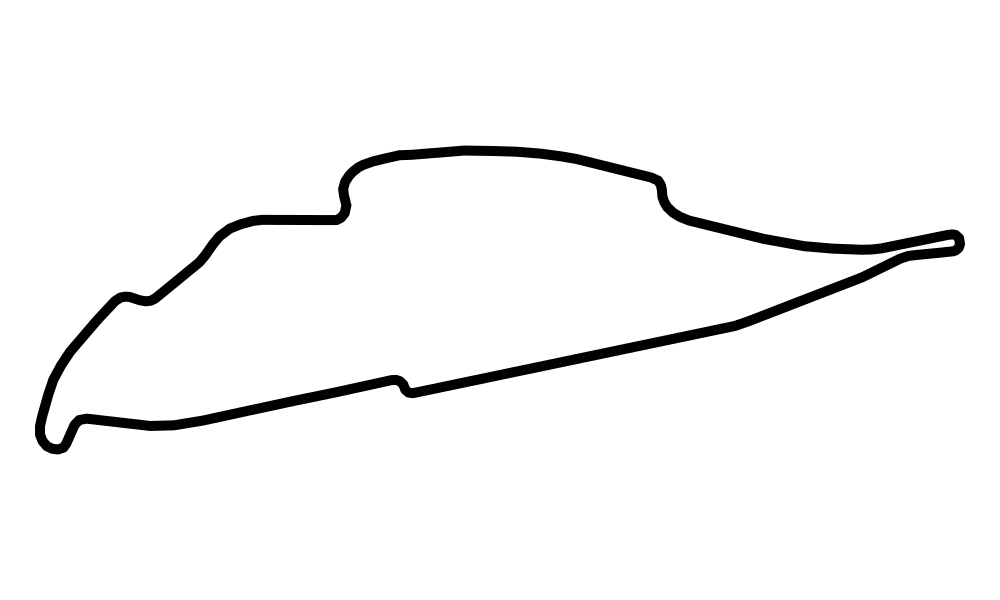
The 1973 Formula 1 season is often remembered as a peak in the rivalry between two of the sport’s greatest luminaries: the methodical Jackie Stewart and the naturally gifted Emerson Fittipaldi. As the circus arrived in Barcelona for the Spanish Grand Prix on April 29, the atmosphere was thick with the scent of Castrol oil and the anticipation of a high-speed duel. The venue was the Montjuïc Park circuit, a terrifyingly fast and undulating street track that wound its way through the hills overlooking the city. Unlike the modern, sanitized facilities of the current century, Montjuïc was a raw, mechanical challenge where the margin for error was non-existent. Lined by steel guardrails and stone walls, it demanded total concentration from drivers grappling with manual gearboxes and the raw torque of the Ford Cosworth DFV engine.
Emerson Fittipaldi entered the weekend as the defending World Champion, having become the youngest title holder in history just the year prior. His car, the Lotus 72E, was a refined version of Maurice Philippe’s revolutionary wedge-shaped design. By 1973, the Lotus 72 was in its fourth year of competition, yet thanks to constant evolution and Colin Chapman’s obsessive pursuit of weight reduction, it remained the class of the field. The 'E' specification featured improved suspension geometry and oil tanks integrated into the rear wing structure, providing the mechanical grip necessary to tackle the elevation changes of the Spanish circuit.
Qualifying: The Lotus vs. Tyrrell Duel
Practice and qualifying sessions at Montjuïc were a testament to the bravery of the era. The circuit’s topography meant that cars were frequently unsettled by bumps while traveling at speeds exceeding 150 mph. Ronnie Peterson, the Swedish 'SuperSwede' and Fittipaldi’s teammate at Lotus, proved that he was perhaps the fastest man over a single lap. Peterson hurled his black-and-gold Lotus 72E around the 3.79-kilometer track to claim pole position with a time of 1:21.8. It was a staggering display of car control, characterized by the sideways, tire-smoking style that became Peterson’s trademark.
Starting alongside him on the front row was the great Jackie Stewart in his Tyrrell 006. Stewart, ever the tactician, focused his setup on race endurance and braking stability, knowing that the heavy fuel loads would punish the components over 75 laps. Emerson Fittipaldi secured the seventh spot on the grid, a somewhat disappointing result attributed to minor ignition troubles during the final qualifying session. However, the Brazilian remained confident; he knew the Lotus 72E was gentle on its Goodyear tyres, a factor that would prove crucial in the heat of the Catalan afternoon.
Race Narrative: A War of Attrition
When the green flag dropped, Ronnie Peterson surged into the lead, followed closely by Stewart and the second Tyrrell of François Cevert. The early stages of the race were a high-speed procession through the park, with the scream of V8 and V12 engines echoing off the stone buildings of the old Olympic site. Peterson looked untouchable, pulling out a small gap as he masterfully managed the traffic. Behind him, Stewart was hounding the Swede, waiting for the slightest opening or a mechanical hiccup. Emerson Fittipaldi, meanwhile, was playing the long game. From seventh on the grid, he began a methodical climb, picking off the McLarens and the Ferraris of Jacky Ickx and Arturo Merzario.
As the race reached the midway point, the brutal nature of the Montjuïc circuit began to take its toll on the machinery. The constant gear changes and heavy braking zones were punishing. On lap 47, the championship battle took a dramatic turn. Jackie Stewart, who had been maintaining a fierce pace in second place, suddenly felt his brake pedal go soft. A failure in the Tyrrell’s braking system forced the Scotsman into the pits and eventually into retirement. This promoted Emerson Fittipaldi to second place, though he still trailed his teammate Peterson by a significant margin.
The Lotus 1-2 looked secure until lap 56, when disaster struck for Peterson. A gearbox failure—specifically a broken driveshaft—brought the Swede's dominant run to a gut-wrenching halt. As Peterson coasted to a stop on the grass, Emerson Fittipaldi swept past to take the lead. For the remaining 19 laps, Fittipaldi demonstrated the composure that earned him his 'Emmo' nickname. He backed off slightly to preserve his transmission and engine, crossing the line nearly 43 seconds ahead of François Cevert. In a surprising turn of events, George Follmer finished third in the Shadow DN1, securing a podium in only his second Grand Prix start—a feat rarely seen in the competitive world of the 1970s.
Aftermath and the Legacy of the Lotus 72
The victory at Montjuïc was a pivotal moment in the 1973 World Championship. It gave Emerson Fittipaldi a 12-point lead over Jackie Stewart, though the Scotsman would eventually mount a legendary comeback to take the title later that year. For Team Lotus, the 1973 Spanish Grand Prix was bittersweet. While they celebrated a win, the mechanical failure of Peterson’s car highlighted the fragility that often accompanied Colin Chapman’s 'lightweight at all costs' philosophy. The Lotus 72E, however, cemented its status as one of the most successful chassis in history, proving it could win on high-speed sweeps and tight street circuits alike.
History also looks back at this race with a degree of somberness. The Montjuïc Park circuit, for all its beauty, was inherently dangerous. Two years later, the 1975 Spanish Grand Prix would be marred by a tragic accident that effectively ended F1 racing at the site. The 1973 event, therefore, remains one of the last 'pure' victories at the venue, representing a time when the risks were accepted as part of the sport's romantic, albeit deadly, allure. Emerson Fittipaldi’s performance that day was a masterclass in staying out of trouble while the giants around him faltered.
Key Takeaways from the 1973 Spanish Grand Prix
- Emerson Fittipaldi's Tactical Brilliance: Winning from 7th on the grid demonstrated Fittipaldi’s ability to manage mechanical stress better than his rivals.
- Mechanical Attrition: The race saw high-profile retirements, including Jackie Stewart (brakes) and Ronnie Peterson (gearbox), proving that reliability was as important as outright speed.
- The Shadow Team's Rise: George Follmer’s third-place finish provided the fledgling Shadow team with instant credibility in the paddock.
- Montjuïc Park’s Complexity: The circuit’s reputation as a "driver's track" was solidified, featuring some of the highest average speeds for a street circuit in that era.
- Lotus 72E Dominance: Despite the age of the design, the Lotus 72 remained the benchmark for aerodynamic efficiency and handling in 1973.
Frequently Asked Questions
Who took pole position for the 1973 Spanish Grand Prix?
Ronnie Peterson took pole position in the Lotus 72E with a time of 1:21.8, narrowly beating out Jackie Stewart’s Tyrrell.
Why did Jackie Stewart retire from the race?
Jackie Stewart was forced to retire on lap 47 due to a total failure of his car's braking system, a common issue on the demanding Montjuïc circuit.
What was significant about George Follmer’s podium?
George Follmer, an American driver, finished third in only his second-ever Formula 1 race, providing the Shadow team with their first-ever podium finish.
Conclusion
The 1973 Spanish Grand Prix remains a quintessential example of the mechanical era of Formula 1. It was a race where the driver had to be in total harmony with a machine that was often on the edge of failure. Emerson Fittipaldi’s triumph was not just a result of his speed, but his deep understanding of the Lotus 72E’s limits. In an age before electronic sensors and real-time telemetry, the 'feel' of the car through the seat of the pants was the only guide a driver had. Fittipaldi’s ability to navigate the treacherous curves of Montjuïc Park for 75 laps without a mistake is why he remains a legend of the sport. As we look back on April 29, 1973, we are reminded of a time when racing was raw, the circuits were unforgiving, and the champions were made of iron. This victory helped define the mid-70s era, showcasing the peak of the Ford Cosworth DFV's dominance and the genius of Colin Chapman’s engineering. While the sport has moved on to safer horizons, the ghosts of the Lotus 72E still scream through the hills of Barcelona every April 29th.
#F1 #F1History #RetroF1 #LotusWritten with AI assistance. How this site works
 Canadian Grand Prix