Miami F1 2026: Hard Rock Stadium Hosts Season Resumption
The Miami Grand Prix marks the first race of the 2026 F1 season's resumption, with Hard Rock Stadium at the centre of a remarkable global sporting confluence.
The Formula 1 circus has descended on Miami this week, with Hard Rock Stadium serving as the dramatic backdrop for what promises to be one of the most hotly anticipated race weekends of the 2026 season. After a mid-season break, the Miami Grand Prix marks the first race of the 2026 campaign's resumption — and the venue itself carries a unique cultural weight that few circuits on the calendar can match. Just four weeks removed from hosting the finals of the prestigious Miami Open tennis tournament, and with the FIFA World Cup looming on the horizon — Miami's Hard Rock Stadium will host seven World Cup matches beginning seven weeks from now — this multipurpose sporting jewel is firmly at the centre of the global sports world. For Formula 1, arriving into that atmosphere is both a privilege and a statement of intent.
Miami has rapidly become one of the most glamorous stops on the F1 calendar since its introduction to the schedule, and in 2026, the race carries even greater significance. The field is navigating an entirely new technical era defined by the 2026 regulations, featuring active aerodynamics and the overtake boost system, and every championship point from here on in could prove decisive. Hard Rock Stadium and its surrounding complex provide the unique urban circuit atmosphere that has made Miami a firm fan favourite, and with the world's sporting spotlight already fixed on this corner of Florida, the pressure — and the excitement — could not be higher.
Hard Rock Stadium: A Venue at the Crossroads of Global Sport
What makes this particular Miami Grand Prix weekend so extraordinary is the sheer confluence of major sporting events gravitating around a single venue in such a compressed timeframe. Hard Rock Stadium is not simply an F1 backdrop — it is a living, breathing symbol of Miami's emergence as one of the world's premier multi-sport destinations.
The Miami Open tennis finals concluded just four weeks before this Formula 1 weekend, meaning the venue's operations and hospitality infrastructure have barely had time to breathe before pivoting to support a completely different sporting spectacle. Managing the logistical demands of elite tennis, then transitioning to the unique requirements of a street-style Formula 1 circuit built around a stadium complex, represents an enormous organisational undertaking — one that Miami's event management teams have now become adept at executing.
Looking seven weeks further ahead, Hard Rock Stadium will open its gates once again, this time for seven FIFA World Cup 2026 matches. The tournament, co-hosted by the United States, Canada, and Mexico, brings with it the largest sporting audience on the planet, and Miami is one of the centrepiece host cities. Formula 1's decision — in partnership with the venue and local organisers — to stage a race in this precise window is no accident. The sport is acutely aware of the marketing goldmine that comes from racing in a city simultaneously buzzing with World Cup anticipation. The global eyeballs, the influx of international visitors already booking trips to Florida, and the sheer cultural energy surrounding Miami in this period all serve as a powerful amplifier for F1's own brand.
For the teams, drivers, and the commercial engine behind Formula 1, this is the kind of symbiotic sporting calendar alignment that money simply cannot buy. The Miami Grand Prix weekend becomes not just a race, but an event — a cultural moment woven into the fabric of one of the most significant summers in American sporting history.
The 2026 Season Resumption: Why This Race Matters More Than Usual
Beyond the spectacle of the venue, the competitive stakes surrounding this Miami Grand Prix are considerable. Returning from a break mid-season always introduces a layer of unpredictability — teams arrive with updated car packages, revised strategies, and in some cases recalibrated driver dynamics shaped by what has already transpired in 2026's opening rounds.
The 2026 technical regulations represent the most sweeping overhaul Formula 1 has undertaken in years. The introduction of active aerodynamics — systems that allow cars to dynamically adjust their aerodynamic profiles in response to speed and driving conditions — has fundamentally changed how engineers approach setup and race strategy. Paired with the overtake boost system, which provides drivers with a short-duration performance increment to facilitate passing, the racing itself has taken on a new tactical dimension that teams are still in the process of fully understanding and exploiting.
McLaren's Lando Norris and Oscar Piastri continue to represent one of the most formidable driver pairings in the paddock, with the Woking outfit having built genuine championship-level machinery across recent seasons. Ferrari, meanwhile, are working to extract the full potential of their package with Charles Leclerc now joined by Lewis Hamilton, who is in his second year with the Scuderia in 2026 following his high-profile move from Mercedes ahead of the 2025 season. The chemistry and strategic coordination between Leclerc and Hamilton remains one of the most compelling narratives of this championship cycle.
At Red Bull, Max Verstappen — four-time world champion — remains the benchmark against which all others are measured, now partnered by Isack Hadjar, who was promoted from Racing Bulls for the 2026 season. Mercedes have their own fascinating storyline with George Russell leading the charge alongside Andrea Kimi Antonelli, now in his second year after graduating as a rookie in 2025. The new-look grid, which also includes Audi in their debut season (rebranded from Sauber) and Cadillac making their inaugural F1 appearance as the championship's 11th team, means the competitive picture in Miami is as complex and multi-layered as any in the sport's recent history.
Miami's Circuit and the Hard Rock Stadium Atmosphere
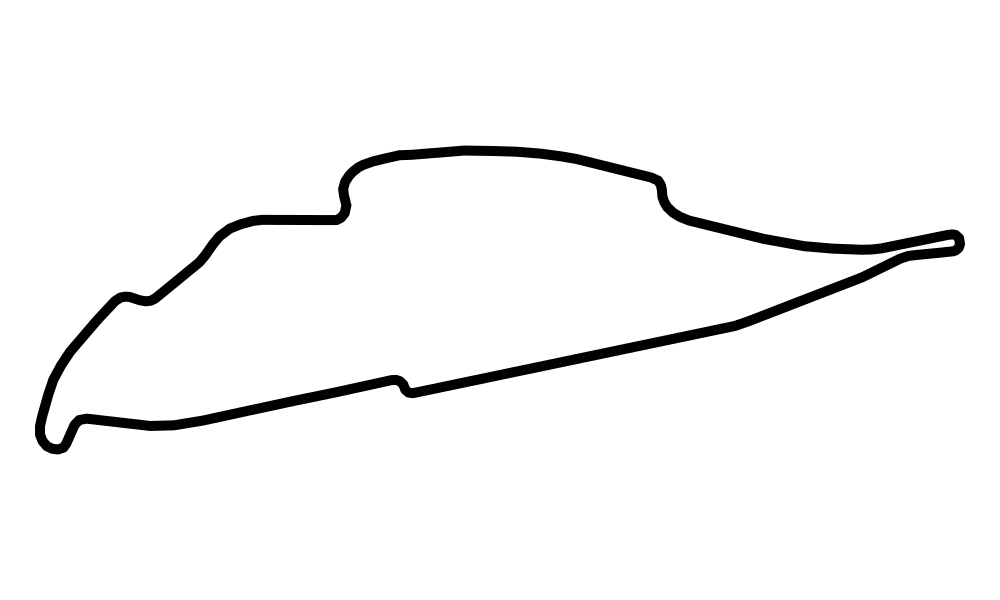
The Miami International Autodrome, laid out around the Hard Rock Stadium complex, is a circuit that has grown in reputation with each passing year. It combines long, high-speed sections that reward aerodynamic efficiency under the new 2026 active aero systems with tighter, more technical sectors where mechanical grip, braking precision, and strategic tyre management come to the fore.
The atmosphere generated by the stadium grandstands is unlike almost any other venue on the calendar. The proximity of the spectators to the circuit, the architectural drama of the stadium looming over sections of the track, and the distinctly American entertainment sensibility that surrounds the event — from the pre-race activations to the post-race concerts — create an environment that has won over even the most traditional sections of the F1 fanbase.
For drivers, Miami presents a particular challenge in terms of track surface evolution over a race weekend. The circuit, constructed on what is effectively a car park and roadway network, tends to rubber in significantly across practice, qualifying, and the race itself, meaning setup calls made on Friday can feel outdated by Sunday afternoon. Under the 2026 regulations, where active aerodynamic systems add another variable for engineers to manage, finding the optimal balance across a full race weekend in Miami is a genuinely complex technical puzzle.
Technical and Strategic Implications of Racing in Miami Post-Break
Returning from a mid-season hiatus always throws a spotlight on which teams have used the break most productively. In the 2026 regulatory environment, with active aerodynamics still being refined and the overtake boost system generating ongoing debate about its deployment strategies, teams that arrive in Miami with meaningful updates or recalibrated software mappings stand to gain a genuine competitive advantage.
The tyre compounds selected by Pirelli for Miami will also play a critical role in shaping race strategy. Miami's abrasive surface and high-energy corners place significant thermal demands on rubber, and under safety car or virtual safety car scenarios — which the Hard Rock Stadium circuit has historically produced — the strategic calculus can shift dramatically in a matter of laps. Teams with the flexibility to execute either a one-stop or a two-stop race strategy, depending on how the race unfolds, will be best positioned to capitalise on the opportunities this circuit presents.
The overtake boost system, which has been one of the defining talking points of the 2026 season so far, takes on particular relevance at a circuit where overtaking opportunities, while present, require precise execution. Drivers and engineers will be acutely focused on managing their boost allocation across the race distance, deploying it at moments of maximum strategic value rather than exhausting it in the early laps.
Key Takeaways
- The Miami Grand Prix marks the first race of the 2026 F1 season's resumption, taking place at Hard Rock Stadium.
- Hard Rock Stadium hosted the Miami Open tennis finals just four weeks prior and will host seven FIFA World Cup 2026 matches seven weeks after the F1 race weekend.
- Miami's position at the intersection of multiple marquee global sporting events amplifies Formula 1's commercial and cultural reach significantly.
- The 2026 technical regulations — featuring active aerodynamics and the overtake boost system — continue to shape the competitive order as teams return from the mid-season break.
- The 2026 grid features notable storylines including Lewis Hamilton's second year at Ferrari, Isack Hadjar's Red Bull debut season, Audi's maiden campaign, and Cadillac's historic F1 entry as the 11th team.
- Miami's circuit characteristics, combined with post-break car development updates, make this one of the most strategically unpredictable rounds on the 2026 calendar.
Frequently Asked Questions
Where is the 2026 Miami Grand Prix being held?
The 2026 Miami Grand Prix is held at the Miami International Autodrome, which is built around the Hard Rock Stadium complex in Miami. Hard Rock Stadium is the same venue that recently hosted the Miami Open tennis finals and will subsequently host seven FIFA World Cup 2026 matches, underlining its status as a world-class multi-sport destination.
Why is the Miami Grand Prix significant for the 2026 F1 season?
The Miami Grand Prix represents the first race of the 2026 F1 season's resumption following a mid-season break, making it a pivotal moment in the championship battle. The race takes place during an extraordinary period for the Hard Rock Stadium venue, sandwiched between the Miami Open tennis finals and the upcoming FIFA World Cup matches, amplifying its global visibility. Combined with the ongoing evolution of the 2026 active aerodynamics regulations, the stakes and narrative richness of this weekend are exceptionally high.
What are the 2026 F1 regulation changes that affect the Miami Grand Prix?
The 2026 Formula 1 season introduced sweeping new technical regulations, most notably the active aerodynamics system, which allows cars to dynamically alter their aerodynamic configuration, and the overtake boost system, which gives drivers a short-duration performance increment to facilitate passing. These changes have significantly altered car design philosophy, race strategy, and the competitive order across the grid. Miami's specific circuit characteristics — including its rubber-in track surface and high-energy corners — interact with these new systems in ways that make setup and strategic decisions particularly complex.
Which teams and drivers are the key contenders at the 2026 Miami Grand Prix?
The primary championship contenders heading into the Miami resumption include McLaren (Lando Norris and Oscar Piastri), Ferrari (Charles Leclerc and Lewis Hamilton, now in his second Ferrari season), and Red Bull (Max Verstappen alongside rookie Isack Hadjar). Mercedes, with George Russell and Kimi Antonelli in his second season, remain a constant threat, while the debuts of Audi and Cadillac as new constructor entrants add further intrigue to the competitive picture.
Conclusion
The Miami Grand Prix in 2026 is far more than a race on a calendar — it is a convergence of sport, culture, commerce, and competition that few venues on the planet could host with the same aplomb as Hard Rock Stadium. Coming just four weeks after the Miami Open tennis finals and positioned seven weeks ahead of the FIFA World Cup action that will grace the same stadium, Formula 1's arrival in Miami this week feels genuinely momentous.
For the championship, the Miami race serves as a critical reset point — a moment where the competitive hierarchy can shift, where mid-season developments are stress-tested, and where drivers and teams alike lay down markers for the second half of the 2026 season. The active aerodynamics era is still being decoded, strategies around the overtake boost system are being refined race by race, and the narrative threads running through this extraordinary grid — from Hamilton's Ferrari chapter to Hadjar's Red Bull baptism to Cadillac and Audi writing the opening lines of their F1 stories — are all alive and evolving.
Miami has proven itself one of the genuinely great modern additions to the Formula 1 calendar. In 2026, at the centre of a sporting summer unlike any other in American history, it may be about to deliver its finest chapter yet.
In this article
Written with AI assistance. How this site works
 Canadian Grand Prix