Mercedes F1 2026: Russell, Antonelli and the Team's Resurgence
Mercedes F1 2026 has opened the new regulatory era with three wins from three rounds, Kimi Antonelli's maiden pole and victory at the Chinese GP, George Russell leading from the front, and Brixworth's power unit setting the benchmark. Inside the Silver Arrows' resurgence.
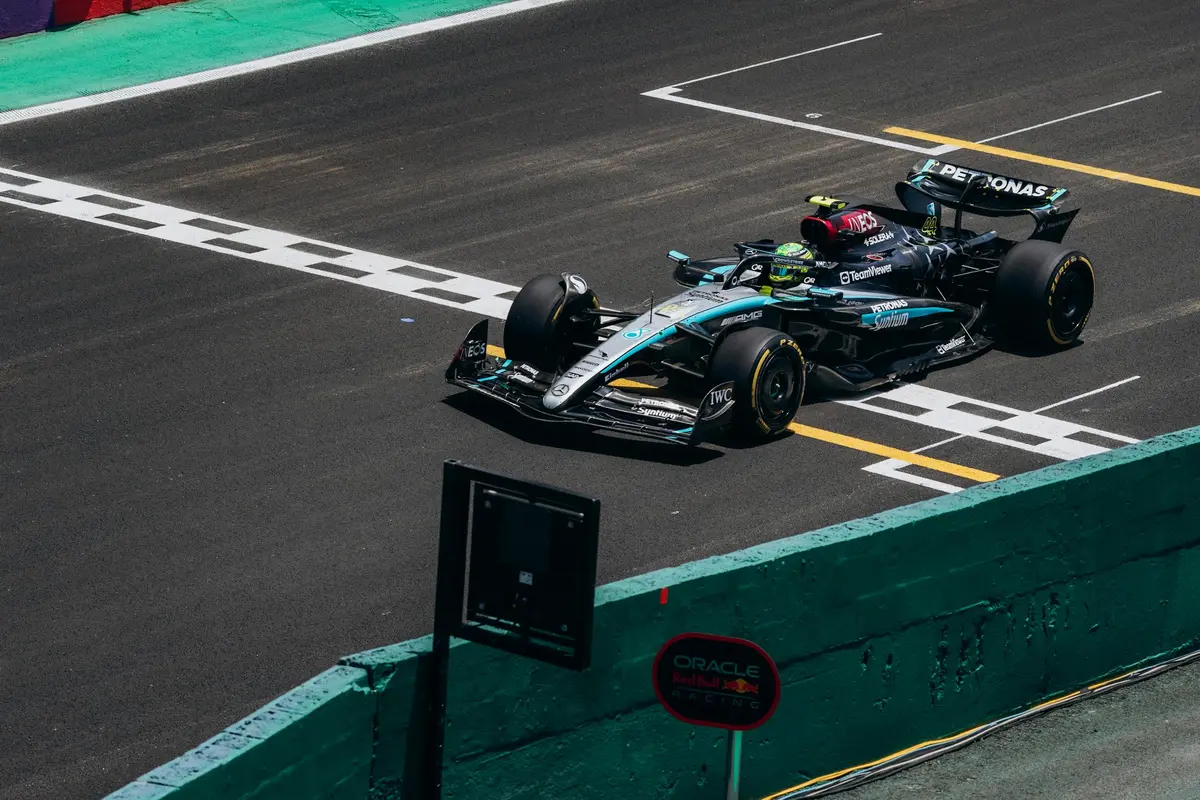
The Mercedes F1 2026 story is the defining narrative of the sport's most radical regulatory reset in a generation. After three seasons in the ground-effect wilderness, the Silver Arrows arrived at the 2026 technical overhaul with a car, power unit and driver pairing that immediately re-established Brackley as the benchmark of Formula 1. George Russell, now the undisputed team leader, and Andrea Kimi Antonelli, the 19-year-old Italian phenomenon entering his sophomore campaign, have combined experience with raw youthful pace to restart a championship engine that had stalled for half a decade. With three victories from the opening three rounds, a maiden pole and win for Antonelli in China, and political scrutiny already circling their front wing, the early Mercedes F1 2026 season has delivered drama on every front.
This pillar brings together every angle of the resurgence: the reset under Toto Wolff, Antonelli's breakthrough, Russell's evolution into a team leader, the Brixworth power unit, the FIA front-wing investigation, the W17's technical trajectory, and the Alpine stake story.
Mercedes F1 2026 Reset: Wolff, Leadership and a New Power-Unit Era
The 2026 regulations represent the most significant technical overhaul in the modern history of Formula 1. A 50/50 power split between the Internal Combustion Engine and the Energy Recovery System, Active Aero front and rear wings that transition between Z-mode (high downforce) and X-mode (low drag), a Manual Override boost replacing DRS, narrower 1.9m cars, a 760kg weight limit and fully sustainable fuels — every line of the technical regulations was rewritten at once. For a team like Mercedes, which had spent 2022 through 2025 chasing a ground-effect car it never fully understood, the reset could not have come at a better time.
Toto Wolff structured the transition with deliberate patience. Lewis Hamilton's move to Ferrari forced a succession plan that Wolff answered by promoting Antonelli from the junior programme and handing Russell the reins as senior driver. The 2025 campaign was a bridge season to bed Antonelli in and calibrate operational systems for the 2026 prize. By Bahrain pre-season testing, the W17 had been optimised around the new power unit philosophy from day one, with no ground-effect inheritance to slow the concept.
Wolff's leadership style has been critical in managing both driver expectations and the political noise that follows a dominant team. At Bahrain testing he emphasised the "human side" of performance, pointing to sports psychologists working with Antonelli to manage the cognitive load of the new regulations. Drivers must synchronise Active Aero transitions, time Manual Override deployments to the millisecond, and manage State of Charge across every lap. The team that masters this operational layer earns tenths before raw car pace is even considered.
Legality is part of Wolff's calculus. Brackley has consistently positioned itself as operating at the edge of the regulations rather than beyond them. When the FIA flagged the W17's front wing after the Chinese Grand Prix, Mercedes engaged in talks, revised the design for Suzuka and publicly downplayed any performance loss — a textbook example of how Wolff handles technical disputes.
Kimi Antonelli's Breakthrough: Maiden Pole and Win at the Chinese GP
Andrea Kimi Antonelli arrived in Formula 1 carrying the weight of being "the driver who replaced Lewis Hamilton." Through a rookie 2025 season he handled that pressure unevenly, with standout flashes of pace punctured by a difficult European stretch through Silverstone, Spa and Monza. The narrative entering 2026 was about whether a sophomore could make the leap from promising rookie to genuine championship contender. By the third round of the season, that question had been answered emphatically.
At the Australian Grand Prix, Antonelli was already on the pace. A high-speed FP3 crash at the exit of Turn 12 at Albert Park — measured at a staggering 32G — briefly threatened his weekend, with potential damage to the W17's Energy Store and gearbox casing under the strict 2026 reliability quotas. Yet by Sunday he had recovered to finish on the podium in third, supporting Russell's victory in a Mercedes 1-2 that stunned the paddock. His 65-lap consistency run at Bahrain testing had convinced Wolff that the maturity was there; Melbourne confirmed it under full racing conditions.
The genuine breakthrough came at the Chinese Grand Prix. Antonelli claimed his maiden Formula 1 pole position and converted it into his first Grand Prix victory, becoming the youngest Italian polesitter and race winner in the sport's modern era. The Q3 lap that sealed pole was described by Mercedes engineers as a masterclass in Active Aero management, with Antonelli delaying the X-mode activation until the car was fully settled and saving maximum Manual Override deployment for the exit of traction-limited corners. Wolff used the result to publicly rebuke the critics who had questioned Antonelli's promotion, framing the weekend as vindication for a long-term investment in youth.
The Chinese weekend also drew FIA probes into the W17's front-wing behaviour under load, though no illegality was established. Back-to-back poles in Bahrain and China — with Antonelli leading the Drivers' Championship ahead of Russell after three rounds — have re-framed the sophomore narrative entirely. What was billed as a development year has become a title campaign. Antonelli's smoother steering inputs and instinctive feel for mid-corner rotation appear to suit the new regulations better than those of several senior drivers on the grid, and his ability to translate simulator work into race pace on circuits he had never driven professionally before has become one of the defining stories of the Mercedes F1 2026 campaign.
George Russell as Team Leader: Race Pace, Standings, Championship Ambitions
Every resurgent team needs a senior driver capable of absorbing political pressure, shaping car development and winning races from the front. George Russell has stepped into that role at Mercedes with precisely the poise Wolff hoped for when he confirmed the British driver as the inheritor of the No. 1 status. Russell won the 2026 Australian Grand Prix opener at Albert Park, leading Antonelli home in a dominant 1-2 that Wolff described afterwards as the moment Mercedes "reclaimed the throne." That result alone, achieved through superior energy management and a decisive response to Ferrari's strategic hesitation, announced the new hierarchy of the 2026 grid.
Russell's race craft in Melbourne was built on the same operational mastery that has defined the early Mercedes F1 2026 season. When Ferrari left Charles Leclerc out for three additional laps during the middle stint rather than covering a Mercedes undercut, Russell's crew executed a high-deployment out-lap strategy that leapfrogged the Ferrari and trapped Leclerc in dirty air for the remainder of the race. It was a tactical knockout, delivered under the new Manual Override rules, and it highlighted why Mercedes rates Russell's strategic communication as the best in the team's recent history.
Qualifying has been more nuanced. At the Chinese Grand Prix, Russell reported an "unstable car" on the radio during a session where Antonelli took a back-to-back pole, with the senior driver finishing second and describing snap oversteer in high-speed transitions. The performance delta between the two cars suggests the W17 has a narrow operating window and that Mercedes is occasionally running two slightly different aero-mapping configurations between the garages. Russell, who excelled in the high-grip era of 2017-2021, is still adapting his instinctive driving style to the "sliding" feel of the 2026 machinery. He has been publicly gracious about Antonelli's pace while making clear, through the data, that he intends to recover the internal benchmark.
Crucially, Russell has accepted leadership responsibilities that extend beyond his own cockpit. When the FIA mandated the W17 front-wing revision for Suzuka, it was Russell who fronted the media and downplayed the impact, framing the modifications as "part of the natural evolution" of a 2026 challenger and protecting his younger teammate from unnecessary noise. Internally, Russell has worked closely with Mercedes' High Performance Powertrains (HPP) engineers in Brixworth on deployment-map development — the kind of technical feedback Lewis Hamilton used to deliver. With the Drivers' Championship alive and the Constructors' title well within reach, Russell's leadership will be tested against a regrouping Ferrari duo of Leclerc and Hamilton in the European leg of the calendar.
Power-Unit Dominance: Bahrain Qualifying and the Brixworth Advantage
If there is a single technical reason why Mercedes F1 2026 has opened the season with a clean sweep of pole positions and victories, it is the power unit built at the HPP facility in Brixworth. The new regulations slashed Internal Combustion Engine output from approximately 550-560kW to 400kW while tripling the battery contribution from 120kW to 350kW. The discipline that now wins races is no longer peak horsepower but rather the sophistication with which a team can harvest, store and deploy electrical energy across a lap. On every one of those sub-metrics, the Brixworth unit appears to be ahead of the grid.
The Bahrain Grand Prix qualifying session offered the clearest evidence. Both Mercedes drivers topped the sessions through superior Manual Override management, using their 350kW electrical boost at the start of the straights to neutralise Ferrari's top-speed advantage while exiting the final corner at Sakhir with more battery reserve than any competitor. Telemetry analysis in the paddock suggested Mercedes was running a more aggressive deployment map than Ferrari or Red Bull without incurring the dreaded "derating" — the moment when electrical energy runs out before the end of a long straight and the car effectively coasts on ICE power alone.
At Albert Park, the advantage translated into race pace. While several teams suffered from MGU-K overheating, both Mercedes W17s finished without a single reported technical glitch. The Ferrari 067/1 power unit is widely considered to have higher peak kinetic recovery efficiency, yet the Mercedes HPP unit has demonstrated more sophisticated deployment software, allowing Russell and Antonelli to use the Manual Override boost more effectively in wheel-to-wheel combat. In a season where thermal efficiency determines deployment aggression, Mercedes appears to have the most thermally stable power unit on the grid.
Rival team principals have acknowledged the Brixworth advantage publicly. Wolff, for his part, has resisted the temptation to celebrate, warning ahead of the Japanese Grand Prix that the paddock's "political knives" were already out for Mercedes — a reference to lobbying efforts by rival teams to have the FIA issue Technical Directives slowing the W17's pace. That wariness is well-founded. Dominant power unit eras in Formula 1 have always attracted regulatory scrutiny, and Mercedes knows from its own 2014-2016 dominance just how quickly an engineering lead can be eroded through clarifications and mid-season directives.
FIA Front-Wing Investigation and Rob Smedley's Defence of Brackley
The first major technical controversy of the 2026 season erupted in the days following the Chinese Grand Prix, when reports emerged of a sophisticated "two-phase closure mechanism" on the W17's front wing. Under the 2026 regulations, cars switch between Z-mode and X-mode for downforce and drag balance, with the transitions governed by standardised active-aero logic. Analysts in the paddock claimed the Mercedes wing was achieving an intermediate aerodynamic state during the transition — a third configuration not explicitly covered by the regulations — that allowed the car to shed drag in a staggered manner while retaining front-end bite for longer into corner entry.
The FIA opened an investigation into whether the mechanism fell within the intended scope of the regulations or constituted an illegal secondary system. Rival teams — reportedly led by Aston Martin, now backed by Adrian Newey's technical leadership, and supported by Ferrari and Red Bull — pushed formally for a Technical Directive. Mercedes engaged in talks with the FIA after Shanghai and, by the Japanese Grand Prix weekend at Suzuka, had introduced a revised front wing that was deemed compliant without any public acknowledgement that the earlier design had been illegal.
One of the most robust public defences of the Brackley engineering team came from Rob Smedley, the respected former Williams and Ferrari engineer, who used his broadcast platform to argue that the two-phase behaviour was a legitimate interpretation of the active-aero framework rather than a deliberate breach. Smedley pointed out that the 2026 regulations contain inherent grey areas in their transition logic and that Mercedes' willingness to revise the design voluntarily — rather than fight a prolonged appeal — demonstrated the team was operating in good faith. His intervention, delivered with the authority of a respected technical voice, helped shift paddock sentiment away from accusations of cheating and toward an acknowledgement that Brackley had simply been first to spot an opportunity.
Russell publicly downplayed the impact of the revisions at Suzuka, describing them as part of the natural evolution of a 2026 challenger and insisting the team had not lost a significant performance step. The on-track results broadly supported him: Mercedes maintained their pace through Japan, and the political temperature subsided. The episode, however, served as a preview of the regulatory battles likely to define the rest of the season.
Technical Trajectory: HPP Data-Sharing with McLaren and Japanese GP FP Sweeps
A less visible but equally important dimension of the Mercedes F1 2026 story is the commercial and technical relationship between Brixworth and the power unit's customer teams — most notably McLaren. Mercedes HPP supplies engines to McLaren under a long-standing partnership, and the 2026 regulations have forced a reckoning over how much data the customer is entitled to receive. Reports through the opening weeks of the season suggested that McLaren had raised concerns about the depth of the technical data flowing from Brixworth, with the Woking team seeking parity with what Mercedes' own race engineers see in real time.
The tension reflects a structural feature of the new rules. Because the 2026 power unit represents such a large proportion of lap-time performance, customer teams are more dependent than ever on the manufacturer's software and mapping. Any perception that Mercedes is withholding deployment information — particularly around Manual Override strategy and State of Charge management — becomes a competitive issue. HPP has publicly reaffirmed its commitment to customer parity, but the data-sharing debate is expected to run through the European leg of the season, especially as McLaren attempts to close the qualifying gap to the works team.
On track, the Japanese Grand Prix weekend at Suzuka provided the clearest early-season demonstration of Mercedes' operational depth. Both Russell and Antonelli topped the timesheets across multiple free practice sessions, sweeping FP1 and FP2 with long-run pace that suggested the revised front wing had not meaningfully compromised performance. The Suzuka result answered the question that had hung over the team since the Chinese Grand Prix: could Mercedes maintain its advantage once the FIA had forced a design change? The free-practice domination indicated yes.
The development trajectory now faces its sternest test through the European leg of the calendar, where upgrade packages from Ferrari, McLaren and Red Bull are expected to arrive in rapid succession. Mercedes has already signalled that the W17's first major upgrade will target high-speed stability — the area where Russell has reported the most difficulty — and Antonelli's simulator work is reportedly focused on finding additional time from Z-mode to X-mode transitions at higher Reynolds numbers. If Brackley can convert its current operational advantage into a sustained development rate, the Mercedes F1 2026 campaign could become the most dominant opening half of a season since the team's 2014-2016 heyday.
Mercedes' Alpine-Stake Story and Wider Business Moves
The final dimension of the Mercedes F1 2026 story is commercial. On 13 March 2026, Flavio Briatore confirmed that high-level discussions were underway regarding the sale of a minority stake in the Alpine team, with Mercedes-Benz identified as the primary suitor. The reported figure of approximately 24 per cent would give Mercedes a significant but non-controlling interest in the Enstone-based outfit. Briatore was careful to clarify that the discussions were being conducted with Mercedes-Benz as a corporate entity rather than with Toto Wolff personally, defusing potential conflict-of-interest concerns that would otherwise have dominated the paddock narrative.
The strategic logic is substantial. A Mercedes stake in Alpine would create a pathway for junior-programme drivers, a second data set on power unit behaviour through a friendly team, and a commercial hedge in a paddock where customer engine relationships are increasingly important. It would not, however, directly impact the 2026 driver lineup of Russell and Antonelli — Wolff has been explicit that the commercial conversation is entirely separate from sporting decisions at Brackley.
Beyond Alpine, Mercedes has continued to invest heavily in its broader F1 ecosystem. HPP has expanded its Brixworth facility to accommodate the increased complexity of the 2026 power unit, and the Brackley factory has added simulator capacity specifically tailored to Active Aero and Manual Override training. The team's sponsorship portfolio, anchored by Petronas and IWC, has been bolstered by new partnerships announced over the winter. These investments reflect a clear message from Stuttgart: the long-term commitment to Formula 1 is not only intact but accelerating, and the Mercedes F1 2026 resurgence is being underwritten by the strongest financial backing Brackley has enjoyed in years.
Key Takeaways
- Three wins from three rounds: Mercedes has swept the opening three Grands Prix of 2026 from pole position, establishing the clearest early-season dominance since the team's 2014-2016 era.
- Antonelli's breakthrough: The 19-year-old Italian secured his maiden pole position and first Grand Prix victory at the Chinese Grand Prix, leading the Drivers' Championship after three rounds.
- Russell's leadership: George Russell has stepped into the senior-driver role with a commanding victory in Melbourne and decisive strategic execution, while mentoring Antonelli through technical controversies.
- Brixworth power-unit advantage: Mercedes HPP has delivered the most thermally efficient and strategically deployable 2026 power unit, extending Brackley's operational edge across qualifying and race pace.
- FIA front-wing scrutiny: The W17's two-phase closure mechanism triggered a mid-season revision after Shanghai, with Rob Smedley publicly defending the legitimacy of Brackley's interpretation.
- Alpine stake discussion: Mercedes-Benz is in corporate-level talks for a reported 24 per cent minority stake in Alpine, separate from any personal involvement of Toto Wolff.
Frequently Asked Questions
How has Mercedes F1 2026 performed in the opening rounds of the season?
Mercedes has won every Grand Prix from pole position through the opening three rounds of the 2026 season, with George Russell winning in Australia and Kimi Antonelli taking his maiden pole and victory at the Chinese Grand Prix. The team sits at the top of the Constructors' Championship, with Antonelli leading the Drivers' standings ahead of Russell.
Why did the FIA investigate the Mercedes W17 front wing?
The FIA opened an investigation after the Chinese Grand Prix into what analysts described as a two-phase closure mechanism in the W17's front wing, which appeared to create an intermediate aerodynamic state between the standard Z-mode (high downforce) and X-mode (low drag) configurations. Mercedes engaged in discussions with the FIA and introduced a revised front wing for the Japanese Grand Prix at Suzuka that addressed the concerns without any public declaration of illegality.
What makes the Mercedes HPP power unit dominant in 2026?
The Brixworth-built power unit has demonstrated superior electrical energy harvesting, thermal efficiency and deployment-software sophistication compared to its rivals. This allows Mercedes drivers to use the 350kW Manual Override boost more effectively in wheel-to-wheel combat while maintaining a higher State of Charge across a full race distance, minimising the derating issues that have affected competitors.
Is Mercedes-Benz buying a stake in Alpine for 2026?
High-level discussions are underway regarding a minority stake in Alpine reported at approximately 24 per cent. Flavio Briatore has confirmed the talks are being held with Mercedes-Benz as a corporate entity, distinct from any personal involvement of Team Principal Toto Wolff. The deal, if completed, would not directly impact Mercedes' 2026 driver lineup of Russell and Antonelli but could create long-term pathways for junior-programme drivers.
Conclusion
The Mercedes F1 2026 season so far reads like a textbook on how to navigate a major regulatory reset. Wolff's patience in handling the Hamilton succession, the Brixworth power unit advantage, Russell's emergence as a genuine championship-caliber team leader, Antonelli's breakthrough victory in China, and even the deft management of the FIA front-wing investigation all point to a Brackley operation that is once again operating at the peak of Formula 1. The Silver Arrows' challenge now is not to reach the front — they are already there — but to defend the position through an intensifying development war as Ferrari, McLaren and Red Bull unlock performance in their own 2026 packages.
With the European leg of the calendar imminent and the political temperature rising, the coming months will determine whether this is the opening chapter of a new Mercedes dynasty or a brilliant but brief moment of supremacy. Either way, the first three races have re-established a pecking order that the paddock feared might be lost forever. The Silver Arrows are back, led by a veteran at the peak of his powers and a 19-year-old who is already rewriting the sophomore-season record books. For neutral fans and Brackley loyalists alike, the 2026 campaign has delivered the most compelling Formula 1 resurgence in a decade.
In this article
Written with AI assistance. How this site works
 Canadian Grand Prix