F1 Miami Grand Prix 2026: Sprint Format, One Practice Session
The 2026 F1 Miami Grand Prix sprint weekend gives teams just one practice session to validate upgrades amid the season's radical regulatory reset.
The 2026 Formula 1 Crypto.com Miami Grand Prix arrives at what many paddock insiders are calling a watershed moment in the season. Following a disrupted opening stretch of the calendar, teams descend on the Hard Rock Stadium complex carrying revised setups, freshly developed upgrade packages, and a stack of unanswered technical questions that only competitive running will resolve. Crucially, this weekend operates under the sprint format — meaning the entire field must compress its discovery process into a single practice session before the competitive action truly begins. In a season already defined by radical regulatory change, the Miami sprint weekend represents one of the highest-risk, highest-reward environments on the calendar. What unfolds here could reshape the championship picture significantly.
Why Miami 2026 Is a Defining Moment in the Season
The phrase "defining moment" is often overused in Formula 1 coverage, but the source framing from Autosport is deliberate and accurate. The 2026 season opened under the most sweeping technical regulations the sport has seen in a generation. Active aerodynamics, the new overtake-boost power unit architecture, revised weight limits, and substantially changed tyre interaction models have meant that every team has effectively been learning a new discipline since pre-season testing. Early rounds were, by multiple accounts, disrupted — whether by weather interruptions, reliability incidents tied to the new hybrid architecture, or simply the chaotic competitive reshuffling that accompanies a regulation reset of this magnitude.
Miami, as the first United States round of 2026, therefore carries additional symbolic and sporting weight. Arriving at this juncture with upgrades bolted on but limited track time to validate them is a scenario that rewards engineering depth and driver instinct in equal measure. Teams that have managed their upgrade sequencing well — and there is every reason to believe McLaren, Ferrari, and Red Bull are among those arriving with meaningful aero packages — will look to convert their preparation into a points advantage during a weekend that, by design, offers fewer data-collection opportunities than a conventional race weekend.
The Sprint Format Pressure Cooker
Miami is one of the designated sprint weekends on the 2026 Formula 1 calendar, and the implications of that format are profound. Under the sprint structure, teams receive only a single practice session — typically 60 minutes — before proceeding directly to Sprint Qualifying. That single session must serve every purpose simultaneously: tyre evaluation, setup refinement, aero validation for any new components, power unit mapping checks, and driver acclimatisation to a circuit that blends medium and high-speed sections with traction-limited slow corners.
For engineers, the sprint weekend is arguably the most intellectually demanding format in modern motorsport. There is no safety net of a second or third free practice session in which to correct a setup miscalculation. A car set up incorrectly after FP1 stays incorrectly set up through Sprint Qualifying — and potentially through Sunday Qualifying as well, if the team lacks the confidence or the tyre data to make aggressive changes. In 2026, with active aerodynamics adding a new variable to every setup decision, this challenge is compounded. Teams must dial in the active aero stall thresholds, the deployment curves of the overtake boost system, and the mechanical platform all within the same limited window.
The driver who can provide precise, actionable feedback from a single 60-minute session becomes disproportionately valuable. This is a skill set that veterans like Fernando Alonso at Aston Martin and Lewis Hamilton — now in his second year at Ferrari — have refined over decades. But equally, technically sophisticated drivers such as Lando Norris at McLaren and Max Verstappen at Red Bull have demonstrated the capacity to read a car quickly and deliver setup direction under compressed timeframes.
Upgrades Arriving at a Complex Circuit
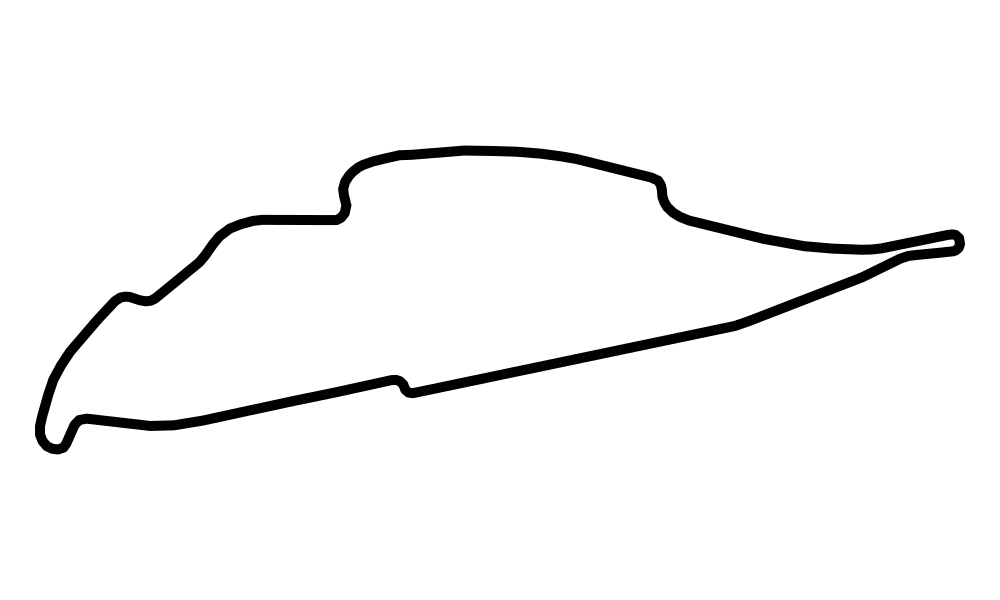
The Miami International Autodrome, built around the Hard Rock Stadium, is a circuit that does not flatter an ill-balanced car. Its layout blends long straights that reward low-drag efficiency with tight, technical sections that demand mechanical grip and strong traction. The combination makes it a genuine all-rounder examination — a car that is strong in one dimension but weak in another will be exposed across the lap, not just in isolated sectors.
This is significant given the source confirmation that teams arrive with upgrades and revised setups. Upgrade packages brought to Miami will be immediately stress-tested across the full spectrum of aerodynamic and mechanical demands. A front-wing update that improves high-speed stability may interact unpredictably with the active aero deployment zones. A floor revision designed to recover downforce lost during the learning phase of the season may exhibit sensitivity to the circuit's kerbing that was not apparent in simulation. With one practice session to identify and address any such issues, the upgrade integration risk is considerable.
Teams With the Most to Prove
Without attributing specific upgrade details beyond what the source text confirms, it is reasonable to note that the disrupted opening stretch of the 2026 season has left several constructors with more to prove than others. Established front-runners who underperformed during the early rounds will be eager to demonstrate that their difficulties were circuit-specific or reliability-related rather than fundamental. Newer entries in the 2026 grid — including Cadillac, in its debut Formula 1 season with Sergio Perez and Valtteri Bottas — face the additional challenge of integrating upgrades on a car that is still in its foundational development phase.
Audi, competing in its first full season under the Audi name after the Sauber rebrand, similarly faces a Miami weekend that will test not just its car but its entire operational infrastructure under sprint-weekend pressure. For Nico Hulkenberg and Gabriel Bortoleto, Miami represents a chance to demonstrate that the Audi project is tracking upward, regardless of where they sit in the constructors' standings.
Context: The 2026 Regulatory Reset and Its Early Consequences
To understand why Miami 2026 feels so consequential, it is necessary to place it within the broader context of the season's regulatory backdrop. The 2026 technical regulations introduced active aerodynamics as a core design philosophy — teams now run bodywork that adjusts its geometry dynamically during a lap rather than relying entirely on fixed aerodynamic surfaces. Combined with the revised power unit regulations, which introduced the overtake boost system as a standardised driver-deployable tool, the performance hierarchy from 2025 was never guaranteed to carry forward.
This reset has produced a grid that, in the early rounds, has been genuinely difficult to predict. Constructor strengths developed over years of incremental refinement under the previous regulations do not automatically translate. Teams that have historically excelled at aerodynamic efficiency may find that the active aero framework rewards different competencies — specifically, control systems engineering and software integration — more heavily than before. This dynamic has been a recurring sub-narrative of the 2026 season's opening phase.
Miami, arriving after teams have had several races to process data and develop their understanding of the new regulations, should theoretically produce a cleaner competitive picture. The upgrades teams carry to Florida are not speculative; they are informed by real-world race data gathered under the new rules. Whether those upgrades translate into lap time at a track as demanding and diverse as the Miami circuit will be one of the weekend's central storylines.
Technical and Strategic Implications of the Sprint Weekend
From a strategic standpoint, the Miami sprint weekend introduces a distinctive points-scoring structure that demands a dual approach. The Sprint Race offers its own points allocation — an opportunity to score that must be balanced against the risk of mechanical stress or competitive damage heading into Sunday's main Grand Prix. For teams operating at the sharp end of the championship, the calculus of how aggressively to race in the Sprint versus how much to manage for Sunday is a live, complex negotiation.
Tyre allocation is another critical dimension. With only one practice session before Sprint Qualifying, teams must make tyre compound choices under significant uncertainty. The Pirelli compounds selected for Miami and the interaction of those compounds with the 2026 cars' updated aerodynamic and mechanical profiles is information that will be incomplete when teams finalise their Sprint Qualifying strategies. Engineers who can extrapolate accurately from limited data — and from whatever simulation work was completed before the weekend — will carry a meaningful advantage.
The active aerodynamics system also introduces a new tactical layer. The precise deployment strategy for the aero stall mechanism — when to open the drag-reduction configuration and when to run maximum downforce — becomes a qualifying-lap optimisation exercise that teams will have had just one hour of real-world data to calibrate. Errors in that calibration could cost multiple tenths across a lap, the difference between a front-row start and a mid-pack grid position in what has been a closely contested 2026 season.
Key Takeaways
- The 2026 Miami Grand Prix is a sprint-format weekend, meaning teams have only one 60-minute practice session to set up their cars before competitive action begins.
- Teams arrive in Miami following a disrupted opening phase of the 2026 season, carrying upgrades and revised setups that have had limited track validation.
- Miami's mixed-profile circuit layout — combining long straights with tight, traction-limited corners — provides a comprehensive test of any upgrade package's effectiveness.
- The 2026 active aerodynamics regulations add a new layer of complexity to sprint-weekend preparation, requiring precise calibration of dynamic aero systems with minimal data.
- Rookie and debut-season programmes — including Cadillac's first F1 season and Audi's rebrand debut — face a particularly demanding sprint-weekend challenge in Miami.
- With championship points available in both the Sprint Race and the Grand Prix, strategic decision-making around risk management and tyre allocation is especially critical.
Frequently Asked Questions
Why is the 2026 Miami Grand Prix a sprint-format weekend?
Formula 1 designates a select number of rounds each season to use the sprint format, which replaces additional practice sessions with a Sprint Qualifying session and a shorter Sprint Race. Miami is one of those designated sprint weekends in 2026, meaning competitive action is compressed and teams receive only one practice session to prepare their cars.
How many practice sessions do teams get at a sprint-format race weekend?
Under the sprint format, teams receive just a single practice session — typically 60 minutes — before Sprint Qualifying takes place. This is in contrast to a conventional race weekend, which provides three practice sessions. The reduced running time means every lap in that single session carries significantly greater operational importance.
How do the 2026 active aerodynamics regulations affect sprint-weekend preparation?
The 2026 active aerodynamics system requires teams to calibrate dynamic bodywork deployment strategies — including when to use drag-reduction configurations and when to hold maximum downforce — as part of their lap setup. With only one practice session available before Sprint Qualifying, teams have very limited real-world data on which to base those calibrations, increasing the margin for error and the reward for superior simulation and engineering work.
Which teams are making their F1 debut or major identity change in 2026?
Two notable new entrants characterise the 2026 grid. Cadillac is competing in its debut Formula 1 season as the sport's 11th constructor, fielding Sergio Perez and Valtteri Bottas. Audi is racing under its own name for the first time in 2026 after the rebranding of the former Sauber entry, with Nico Hulkenberg and Gabriel Bortoleto as its drivers. Both programmes face the sprint weekend's compressed timeframe while still developing their fundamental car concepts.
Conclusion
The 2026 Formula 1 Crypto.com Miami Grand Prix is not merely another stop on the calendar. It is a convergence point — the first United States event of the year, a sprint-format weekend that demands excellence under pressure, and an early staging post for the real competitive reckoning of a season shaped by the most ambitious regulatory reset in the sport's recent memory. Teams carry upgrades informed by the disrupted opening rounds, but with only one hour to validate them before competitive pressure begins, the margin for error is vanishingly small.
For drivers, engineers, and strategists alike, Miami 2026 is the kind of weekend that separates good teams from great ones. The sprint format removes safety nets, the circuit demands balance across every performance dimension, and the active aero regulations ensure that the performance variables are more complex than they have been in any previous generation of cars. Whether it is an established front-runner consolidating an early championship advantage or an ambitious new entry announcing itself on the world stage, the Miami sprint weekend will generate answers — and new questions — that will define how the 2026 Formula 1 season unfolds in the months ahead.
In this article
Written with AI assistance. How this site works
 Canadian Grand Prix