F1 2026: How Time Management Defines Team Success
Time management is the invisible factor separating F1 winners from also-rans — and in 2026, under sweeping new regulations, it has never been more critical.
In Formula 1, success is rarely defined by a single moment of brilliance. Instead, it is forged in the relentless, invisible battle against the clock — a war waged not just on track, but deep inside the factories, design offices, and simulation suites of every team on the grid. As the 2026 season unfolds under a radically new technical regulatory framework, the concept of time — its planning, its allocation, and its ruthless scarcity — has never mattered more. Every millisecond of lap time saved is preceded by thousands of hours of meticulous human effort behind the scenes.
The Invisible Race: Time as the Ultimate F1 Resource
When fans watch a Formula 1 Grand Prix weekend, they witness the polished, high-speed result of months — sometimes years — of preparation. What they rarely see is the intricate choreography that underpins every team's operation. According to a deep-dive analysis by Autosport, time is the defining invisible factor in Formula 1, separating those who succeed from those who fall short. Every detail is planned, every task is meticulously timed, and every margin for error is compressed to near zero.
This reality is particularly acute in 2026, as teams navigate the most sweeping regulatory overhaul the sport has seen in years. The introduction of active aerodynamics — including the new overtake boost system — alongside a revised power unit formula featuring a significantly increased electrical energy deployment component, has demanded that every team essentially rebuild their car philosophy from the ground up. Design and development cycles that once had comfortable lead times have been compressed, forcing engineering departments to run parallel workflows at a scale and pace rarely seen before.
Teams like McLaren and Ferrari, who arrive in 2026 carrying strong operational momentum, have invested heavily in the infrastructure required to manage time effectively. But even for the most well-resourced outfits, the pressures are immense. For new or restructured entries — most notably Cadillac, making its full F1 debut this season, and Audi, which rebranded from Sauber and launched its own power unit programme — the time constraints are existential. There is no margin for a delayed component, a missed CFD iteration window, or a wind tunnel booking that slips by a week.
2026 Regulations: A Development Race Against the Clock
The 2026 technical regulations have effectively reset the competitive order. Every team started from a near-blank sheet of paper, and the squads that managed their development time most efficiently were best positioned when the season-opening lights went out. This is not merely about raw spending power — it is about the quality of decision-making under time pressure.
Active aerodynamics, one of the most complex and novel elements of the 2026 rules, requires a level of software integration and systems engineering that is entirely new to the sport. Teams must coordinate mechanical design, aerodynamic surfaces, control systems, and power unit mapping in tightly interlocked development loops. A delay in one area cascades across the entire programme. The teams that built robust scheduling processes — with clear critical-path analysis and realistic contingency buffers — have a structural advantage over those that did not.
On the power unit side, the shift to a near-50/50 split between internal combustion and electrical power has placed enormous pressure on manufacturers. For customer teams, the timeline is dictated by their supplier; for works teams, the burden falls entirely on their own engineers. Managing the co-development of chassis and power unit on a shared timeline, with fixed homologation deadlines, is a logistical challenge of the highest order.
The Human Cost of Compressed Timelines
Behind the technical complexity lies a human story. The engineers, designers, aerodynamicists, and mechanics who populate Formula 1's paddock are operating under sustained pressure. Time management at the team level filters down to individual workloads: overnight parts manufacture, transatlantic freight logistics, and back-to-back race weekends across multiple continents compress what little recovery time exists. The teams that sustain performance across a full season are often those that manage not just technical time, but human time — protecting their people from burnout while maintaining maximum output.
Why This Matters for the 2026 Championship
The competitive implications of time management are direct and measurable. A team that consistently delivers aerodynamic updates one race earlier than its rival compounds its advantage over a 24-race calendar. In the 2026 era, where the new regulations have tightened the performance window between the top teams, these incremental gains from disciplined development scheduling could be the difference between a championship and a near miss.
For drivers like Max Verstappen, Lando Norris, and Charles Leclerc — each of whom heads into 2026 as a legitimate title contender — the car they receive on any given weekend is a direct product of how well their team managed time in the preceding weeks. Driver talent remains paramount, but it can only be expressed through machinery that arrives at the track fully developed, reliably prepared, and continuously improving.
Key Takeaways
- Time management is identified as the invisible, critical factor separating success from failure in Formula 1.
- The 2026 regulatory overhaul — featuring active aerodynamics and a new power unit formula — has intensified pressure on team development schedules.
- New entrants Cadillac and Audi face the steepest time-management challenges as they establish their F1 programmes from scratch.
- Active aerodynamics requires tightly integrated, multi-disciplinary development loops where delays in one area cascade across the entire programme.
- Human resource management — protecting engineering staff from burnout — is an extension of time management at the organisational level.
- Teams that consistently deliver updates ahead of rivals compound their advantage across a 24-race season.
Frequently Asked Questions
Why is time management so critical in Formula 1 in 2026?
The 2026 season introduced a comprehensive set of new technical regulations, including active aerodynamics and a revised power unit formula. These changes required teams to essentially design entirely new cars, compressing already tight development cycles and making efficient time management a primary competitive differentiator.
How does the 2026 active aerodynamics system affect team development timelines?
Active aerodynamics integrates mechanical, aerodynamic, software, and power unit systems in a way that has no direct precedent in recent F1 history. Because these systems are deeply interdependent, a delay in any single sub-system can cascade across the entire development programme, making careful scheduling and critical-path management essential.
Which teams face the greatest time-management challenges in the 2026 F1 season?
Cadillac, making its debut as the sport's 11th team, and Audi, launching under its own name after rebranding from Sauber, face the steepest challenges. Both organisations are establishing or scaling major F1 infrastructure from the ground up, meaning every hour of development time carries outsized importance relative to more established outfits.
Conclusion
Formula 1 has always been a sport defined by marginal gains, but the 2026 season has elevated the importance of time — in all its forms — to an unprecedented degree. From factory scheduling to freight logistics, from power unit homologation deadlines to race-weekend preparation, the teams that master time will master the championship. As Autosport's analysis makes clear, the stopwatch never stops in Formula 1: it simply moves from the circuit to the drawing board and back again, relentlessly, without pause. The teams that understand this — and build their entire operations around it — are the ones who will be standing on the podium when the season concludes.
In this article
Written with AI assistance. How this site works
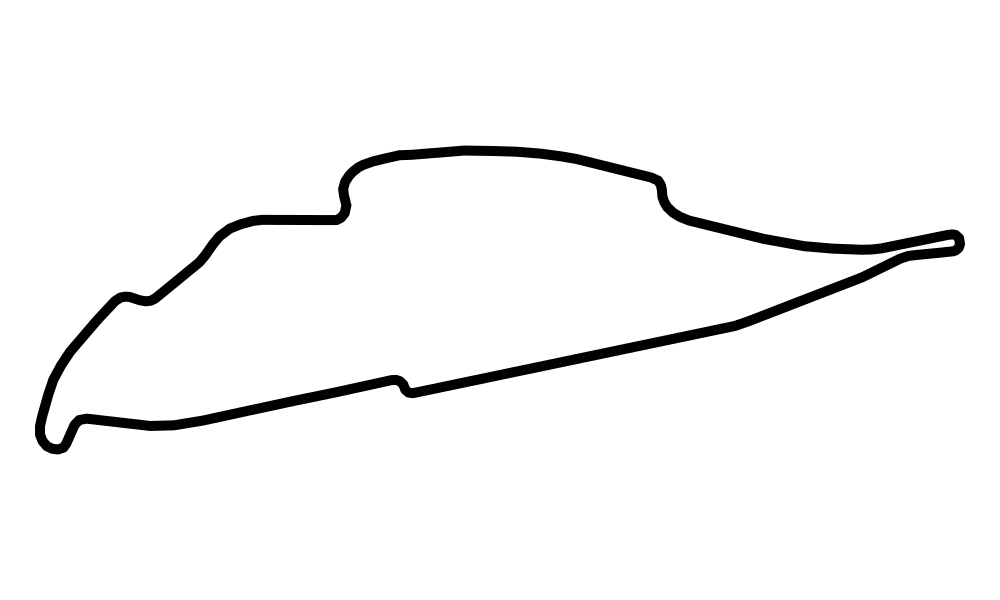
 Canadian Grand Prix